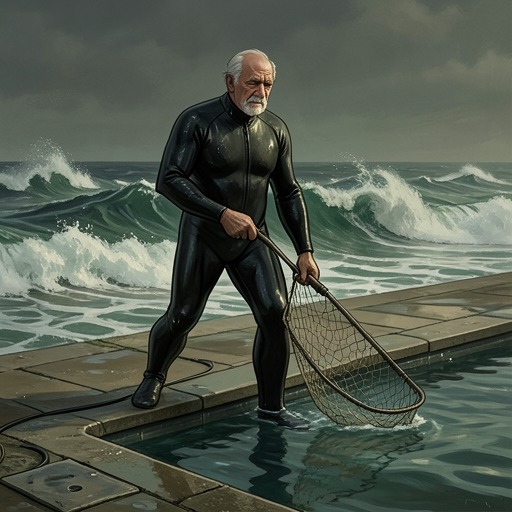
Marcellus McSquiddles
Remarkably Bright CreaturesMarcellus McSquiddles is a Giant Pacific octopus confined in the Sowell Bay Aquarium, but he is never merely an exhibit: he is a sharp-minded narrator whose return to the sea becomes an act of freedom and a quiet answer to Tova Sullivan’s grief. His story joins the material limits of captivity and a short life to the ocean’s vastness, where he encounters a clue to the human loss that shapes Tova’s life.
Identity and Narrative Voice
Marcellus knows his species from the plaque beside his enclosure, but the plaque does not give his name. Terry Bailey, who runs the aquarium, sometimes tells visitors that the octopus is named Marcellus; Terry’s young daughter chose the full, deliberately outlandish name Marcellus McSquiddles. The name’s resemblance to a squid is, in Marcellus’s view, an insult: he is an octopus, not a squid.
The distinction between the name he possesses and the way people see him is central to his wry account of captivity. Visitors typically point him out as “that guy,” noticing only the tentacles behind a rock. Marcellus, by contrast, reads and reflects on what humans say and do. His dry confidence gives the aquarium scenes an alternative point of view: the humans may regard him as an attraction, but he is also watching them.
The plaque supplies another fact he cannot ignore: the average lifespan of a Giant Pacific octopus is four years. The book marks his captivity in numbered days, including Day 1,300, making the passage of time inside the tank an explicit measure of the life he has left.
Captivity and the Memory of the Sea
Before his capture, Marcellus lived in the open water. He cannot fully remember that earlier life, yet he describes still being able to taste the cold currents. At the aquarium, he waits each evening for the overhead lights to click off, leaving the main tank glowing in near-darkness. The dimness is not the sea, but it offers a faint likeness of the deep environment he misses.
His memory of the ocean holds more than a general longing for freedom. When he was young and still at sea, he found a key attached to a circular ring among objects gathered under rocks: a rubber sneaker sole, a vinyl shoelace, and plastic buttons. He understands these as human remnants and connects them to the person Tova mourns. Later, when he encounters a matching key in the aquarium, he recognizes it from that earlier discovery and resolves to return it to her. The ocean has preserved a trace of human loss, and Marcellus carries that trace into his relationship with Tova.
Connection with Tova Sullivan
Tova learns from Terry that Marcellus has been “going rogue again,” and discovers that the octopus has a name. When she approaches him, she touches the top of his mantle and greets him by name. Marcellus winds an arm around her hand, reaches up to investigate her chin, and studies her at close range; another arm explores her freshly done hair. Their contact is strange and tentative, but the scene makes their attention to one another unmistakable.
Marcellus’s understanding of Tova is not based only on that meeting. The key’s earlier counterpart, found among the remains on the seafloor, leads him to recognize its connection to the son she mourns. He returns the key as the least he can do for her. In this way, his knowledge of the sea becomes a form of care: he cannot undo the loss, but he can restore an object that links Tova to it.
Release and Return to the Deep
By the time Tova takes Marcellus to the waterfront, his condition has worsened. His eye is rheumy, and Terry has told her that he may have only weeks or days left. Tova asks what she will do without him, then decides to take him home. She pulls his roughly sixty-pound body in a yellow bucket along the boardwalk toward the jetty, a striking effort for a woman described as seventy years old and weighing no more than ninety pounds. Marcellus trails an arm on either side of the bucket as if enjoying the breeze.
Tova releases him by the water. He swims away from the rocks and descends toward the unlit depths, returning to the place where, as a juvenile, he found the key. There he settles beside the long-disintegrated bones of a beloved son. He has not escaped death; he has escaped the tank in which he expected to die. His final narration names the darkness as a comfort and the sea as home.
Narrative Significance
Marcellus’s arc reverses the human tendency to treat him as an exhibit or an amusing creature with an absurd name. The narrative gives him memory, judgment, humor, and the capacity to recognize another being’s grief. At the same time, it does not make his release a cure for his illness or a promise of a long life: the sea offers him a final return, not a reprieve from mortality.
His movement from the glass enclosure to open water also brings two forms of loss into contact without collapsing them. Tova’s son remains gone, and Marcellus is near death; yet the key he returns and the final place he chooses connect Tova’s human grief to the ocean that concealed its evidence. His freedom is brief, but it lets him end not as an aquarium specimen, but in the darkness he remembers and calls home.